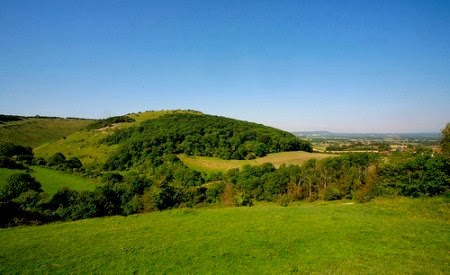
WHEN I am living in the Midlands
That are sodden and unkind,
I light my lamp in the evening:
My work is left behind;
And the great hills of the South Country
Come back into my mind.
The great hills of the South Country
They stand along the sea;
And it's there walking in the high woods
That I could wish to be,
And the men that were boys when I was a boy
Walking along with me.
The men that live in North England
I saw them for a day:
Their hearts are set upon the waste fells,
Their skies are fast and grey;
From their castle-walls a man may see
The mountains far away.
The men that live in West England
They see the Severn strong,
A-rolling on rough water brown
Light aspen leaves along.
They have the secret of the Rocks,
And the oldest kind of song.
But the men that live in the South Country
Are the kindest and most wise,
They get their laughter from the loud surf,
And the faith in their happy eyes
Comes surely from our Sister the Spring
When over the sea she flies;
The violets suddenly bloom at her feet,
She blesses us with surprise.
I never get between the pines
But I smell the Sussex air;
Nor I never come on a belt of sand
But my home is there.
And along the sky the line of the Downs
So noble and so bare.
A lost thing could I never find,
Nor a broken thing mend:
And I fear I shall be all alone
When I get towards the end.
Who will there be to comfort me
Or who will be my friend?
I will gather and carefully make my friends
Of the men of the Sussex Weald;
They watch the stars from silent folds,
They stiffly plough the field.
By them and the God of the South Country
My poor soul shall be healed.
If I ever become a rich man,
Or if ever I grow to be old,
I will build a house with deep thatch
To shelter me from the cold,
And there shall the Sussex songs be sung
And the story of Sussex told.
I will hold my house in the high wood
Within a walk of the sea,
And the men that were boys when I was a boy
Shall sit and drink with me.
~Hilaire Belloc
PELAGIUS lived at Kardanoel
And taught a doctrine there
How, whether you went to heaven or to hell
It was your own affair.
It had nothing to do with the Church, my boy,
But was your own affair.
No, he didn't believe
In Adam and Eve
He put no faith therein!
His doubts began
With the Fall of Man
And he laughed at Original Sin.
With my row-ti-tow
Ti-oodly-ow
He laughed at original sin.
Then came the bishop of old Auxerre
Germanus was his name
He tore great handfuls out of his hair
And he called Pelagius shame.
And with his stout Episcopal staff
So thoroughly whacked and banged
The heretics all, both short and tall —
They rather had been hanged.
Oh he whacked them hard, and he banged them long
Upon each and all occasions
Till they bellowed in chorus, loud and strong
Their orthodox persuasions.
With my row-ti-tow
Ti-oodly-ow
Their orthodox persuasions.
Now the faith is old and the Devil bold
Exceedingly bold indeed.
And the masses of doubt that are floating about
Would smother a mortal creed.
But we that sit in a sturdy youth
And still can drink strong ale
Let us put it away to infallible truth
That always shall prevail.
And thank the Lord
For the temporal sword
And howling heretics too.
And all good things
Our Christendom brings
But especially barley brew!
With my row-ti-tow
Ti-oodly-ow
Especially barley brew!
~Hilaire Belloc
“THE strength of Calvin’s action, therefore, and his creative power, lay in the strictly logical, orderly, and defined arrangement of his new body. It grew through its local churches and their enthusiastic adherents much as Communism today grows, by cells, and though it was democratic in appeal through its system of election, yet it was excessively authoritative in practice through its superadded doctrine that the officers on which that army depended—that is, the ministers of the Church, the elected presbyters—once elected and ordained, could no longer be questioned. Calvin stands thus at the origin of a whole group of interconnected modern ideas which have had the greatest effect upon the developments of politics and philosophy in the centuries following.
Thus the parliamentary institution, which is no increasingly distasteful to the European mind, derives ultimately from Calvin, for it is based on the idea of electing a deputy and then giving the deputy absolute power over the electors. Again, the Monist conception, the idea that all things are one and that spiritual and material forces have the same root—the philosophy underlying modern materialist science—derives from Calvin’s doctrine of there being only one will in the universe. Indirectly (as we shall see later) a consequence of even greater importance followed from Calvin’s definitions and the powerful organization he inspired. For it is to these that ultimately the growth of Capitalism can be traced, against which today the whole world is in revolt.
The effects of Calvin herein is indirect, but nonetheless strong. In denying the efficacy of good deeds and of the human will, of abnegations, in leaving on one side as useless all the doctrine and tradition of Holy Poverty. Calvin opened the door to the domination of the mind by money. St. Thomas had said it centuries before—that if men abandoned the idea of God as the supreme good they would tend to replace Him by the idea, implicit, not directly stated, but of high practical effect, that material wealth is the supreme good. Calvin never said in so many words, and indeed, never thought that men should principally pursue the accumulation of wealth, but he broke down the barriers which Catholicism had erected against that perilous force, and, following on his action, Christendom began to turn to the idea of wealth as at least the only certain good, and therefore the main thing to be aimed at.
Calvin himself would have said with learning, sincerity, and zeal that the glory of God was the only object worthy of human activity, but as he divorced such activity from the power of saving the individual soul, what could there remain save the pursuit of riches?”
~Hilaire Belloc: The Crisis of Civilization.
“I SAY that our interest lies in the question of degree. It always does. The philosopher said: “All things are a matter of degree, and who shall establish degree?” But I think we are agreed – and by “we” I mean all educated men with some knowledge of the world around us – that the degree to which the suppression of truth, the propagation of falsehood, the artificial creation of opinion, and the boycott of inconvenient doctrine have reached in the great Capitalist Press for some time past in England, is at least dangerously high.”
~Hilaire Belloc: The Free Press, Ch. VIII.
“FOR the strength of a newspaper owner lies in his power to deceive the public and to withhold or to publish at will hidden things: his power in this terrifies the professional politicians who hold nominal authority: in a word, the newspaper owner controls the professional politician because he can and does blackmail the professional politician, especially upon his private life. But if he does not command a large public this power to blackmail does not exist; and he can only command a large public – that is, a large circulation – by interesting that public and even flattering it that it has its opinions reflected – not created – for it.”
~Hilaire Belloc: The Free Press: An Essay on the Manipulation of News and Opinion, and How Counter It.
THERE are three phases in the life of man, so far as his thoughts upon his surroundings are concerned.
The first of these is the phase of youth, in which he takes certain matured things for granted, and whether he realizes his illusion or no, believes them to be eternal. This phase ends sharply with every man, by the action of one blow. Some essence is dissolved, some binding cordage snaps, or some one dies.
I say no matter how clearly the reason of a man tells him that all about him is changeable, and that perfect and matured things and characters upon whose perfection and maturity he reposes for his peace must disappear, his attitude in youth towards those things is one of a complete security as towards things eternal. For the young man, convinced as he is that his youth and he himself are there for ever, sees in one lasting framework his father's garden, his mother's face, the landscape from his windows, his friendships, and even his life; the very details of food, of clothing, and of lesser custom, all these are fixed for him. Fixed also are the mature and perfect things. This aged friend, in whose excellent humour and universal science he takes so continual a delight, is there for ever. That considered judgment of mankind upon such and such a troubling matter, of sex, of property, or of political right, is anchored or rooted in eternity. There comes a day when by some one experience he is startled out of that morning dream. It is not the first death, perhaps, that strikes him, nor the first loss—no, not even, perhaps, the first discovery that human affection also passes (though that should be for every man the deepest lesson of all). What wakes him to the reality which is for some dreadful, for others august, and for the faithful divine, is always an accident. One death, one change, one loss, among so many, unseals his judgment, and he sees thenceforward, nay, often from one particular moment upon which he can put his finger, the doom which lies upon all things whatsoever that live by a material change.
The second phase which he next enters is for a thoughtful man in a sceptical and corrupted age the crucial phase, whereby will be determined, not indeed the fate of his soul, but the justice, and therefore the advantage to others, of his philosophy.
He has done with all illusions of permanence and repose. Henceforward he sees for himself a definite end, and the road which used to lead over the hills and to be lost beyond in the haze of summer plains now leads directly to a visible place; that place is a cavern in the mountain side, dark and without issue. He must die. Henceforward he expects the passing of all to which he is attached, and he is braced against loss by something lent to him which is to despair as an angel is to a demon; something in the same category of emotion, but just and fortifying, instead of void and vain and tempting and without an end. A man sees in this second phase of his experience that he must lose. Oh, he does not lose in a gamble! It is not a question of winning a stake or forfeiting it, as the vulgar falsehood of commercial analogy would try to make our time believe. He knows henceforward that there is no success, no final attainment of desire, because there is no fixity in any material thing. As he sits at table with the wisest and keenest of his time, especially with the old, hearing true stories of the great men who came before him, looking at well-painted pictures, admiring the proper printing of collected books, and praising the just balance of some classical verse or music which time has judged and made worthy, he so admires and enjoys with a full consciousness that these things are flowing past him. He cannot rely; he attempts no foothold. The equilibrium of his soul is only to be discovered in marching and continually marching. He now knows that he must go onward, he may not stand, for if he did he would fall. He must go forward and see the river of things run by. He must go forward—but to what goal?
There is a third phase, in which (as the experience of twenty Christian centuries determines) that goal also is discovered, and for some who so discover it the experience of loss begins to possess a meaning.
What this third phase is I confess I do not know, and as I have not felt it I cannot describe it, but when that third phase is used as I have suggested a character of wisdom enters into those so using it; a character of wisdom which is the nearest thing our dull time can show to inspiration and to prophecy.
It is to be noted also that in this third phase of man's experience of doom those who are not wise are most unwise indeed; and that where the age of experience has not produced this sort of clear maturity in the spirit, then it produces either despair or folly, or an exaggerated shirking of reality, which, being a falsehood, is wickeder than despair, and far more inhuman than mere foolishness. Thus those who in the third phase of which I speak have not attained the wisdom which I here recognize will often sink into a passion of avarice, accumulating wealth which they cannot conceivably enjoy; a stupidity so manifest that every age of satire has found it the most facile of commonplaces. Or, again, those who fail to find wisdom in that last phase will constantly pretend an unreal world, making plans for a future that cannot be there. So did a man eleven years ago in the neighbourhood of Regent Street, for this man, being eighty-seven years of age, wealthy, and wholly devoid of friends, or near kindred, took a flat, but he insisted that the lease should be one of not less than sixty years. In a hundred ways this last phase if it is degraded is most degraded; and, though it is not worst, it is most sterile when it falls to a mere regret for the past.
Now it is here that the opposite, the wisdoms of old age appears; for the old, when they are wise, are able to point out to men and to women of middle age what these least suspect, and can provide them with a good medicine against the insecurity of the soul. The old in their wisdom can tell those just beneath them this: that though all things human pass, all bear their fruit. They can say: "You believe that such and such a woman, with her courtesy, her travel, her sharp edge of judgment, her large humanity, and her love of the comedy of the world, being dead can never be replaced. There are, growing up around you, characters quite insufficient, and to you, perhaps, contemptible, who will in their fruiting display all these things." There never was, nor has been, a time (say those who are acquainted with the great story of Europe) when Christendom has failed. Out of dead passages there has sprung up suddenly, and quite miraculously, whatever was thought to be lost. So it has been with our music, so with the splendour of our armies, so with the fabric of our temples, so with our deathless rhymes. The old, when they are wise, can do for men younger than they what history does for the reader; but they can do it far more poignantly, having expression in their eyes and the living tones of a voice. It is their business to console the world.
~Hilaire Belloc: from On Something. London: Methuen & Co., 1910.
"THE men of the Desert are afraid of wine. They have good reason; if you drink wine in the Desert you die. In the Desert, a man can drink only water; and, when he gets it, it is like diamonds to him, or, better still, it is like rejuvenation. All our long European legends which denounce and bring a curse upon the men who are the enemies of wine, are legends inspired by our hatred of the thing which is not Europe, and that bounds Europe, and is the enemy of Europe."
~Hilaire Belloc: The Man of the Desert. (in "Hills and the Sea")