Saturday, July 14, 2018

Hilaire Belloc died July 16, 1953

Belloc in his home
I have quoted here a few paragraphs regarding Belloc's final days from Joseph Pearce's superlative biography, Old Thunder: A Life of Hilaire Belloc.

“On 12 July, Eleanor Jebb discovered her father lying near the fireplace in a smoke-filled room. He had apparently fallen while poking the fire and had stumbled into the embers. Suffering from burns and from shock, he was taken to the Mount Alvernia nursing home of the Franciscan Missionaries at Guildford. A statue of the Blessed Virgin was taken from King’s Land and placed in his room where he could see it. On the evening of 13 July received the Last Sacraments. Two days later, on the Feast of Our Lady of Mount Carmel, Belloc died, a few days short of his eighty-third birthday. 

“The funeral took place at West Grinstead parish church on 20 July. Following the Requiem Mass, Belloc’s body was lowered beneath the soil of his beloved ‘South Country’ and beside the body of his beloved wife. After a separation of almost 40 years, they were once more together. Parted by death’s devastation, they were now reunited by its embrace.

“The tributes poured in from friends and enemies alike. His co-religionists hailed the death of a hero. The Tablet devoted an entire issue to his memory with contributors, such as Douglas Woodruff, Ronald Knox, Christopher Hollis, James Gunn, Frank Sheed and the Bishop of Southwark queuing up to pay homage. To Knox he was ‘a Master of English Prose’, to the Bishop of Southwark a ‘Champion of the Church’. ‘Christendom has lost a great swordsman,’ lamented his old friend D.B. Wyndham Lewis in the News Chronicle, ‘more rigorous and sustained in an attack than Chesterton, less chary of wounding an opponent’s feelings, better equipped than his friend perhaps for dueling à outrance by reason of his French blood . . .’ The paying of homage was not, however, the preserve of Catholics, as the Catholic Herald proclaimed proudly, ‘The Nation Pays Tribute to the Master.’ MacDonald Hastings, writing in the Daily Express, declared that ‘Hilaire Belloc was the last of the giants of the golden age of English literature.’ The Daily Mail concurred, declaring him ‘the last of the giants’. The leader-writer in The Times placed Belloc ‘somewhere between Mr Pickwick and Dr Johnson’, echoing Father Martin D’Arcy’s dubbing Belloc as the ‘Catholic Dr Johnson’.”  

—Old Thunder: A Life of Hilaire Belloc, Chap. 31—The Fading.


Tuesday, July 3, 2018

Democracy

“DEMOCRACY, that is, the government of the community by the community: a state wherein a man stands equal with his fellows, and has to suffer neither subservience nor the corruption of flattery and power; a state in which office alone commands, and not being clothed with office—that is the ideal at the back of every man’s mind who cares for right in public affairs, and who has within himself anything left of private honor. It is simplest put by saying that democracy is the noblest form of government.”

~Hilaire Belloc: The Cruise of the Nona.

Saturday, June 30, 2018

The Small Producer

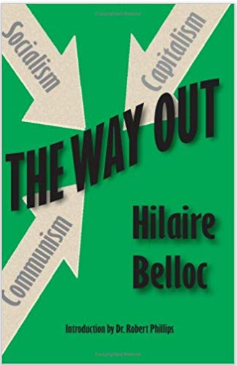
“IT IS imperative in the cause of civilization, that we save the small producer and the small distributor. I call him “small” in contrast to those huge agglomerations of capital which have bred communism and half the other evils of our time. But I do not use this word “small” to make him out an unimportant person. He is all-important to human society and, under a scheme of properly distributed property, though his property would not be large it would be sufficient for his independence, his dignity and the security of his livelihood.

“At any rate the name does not matter. The point is that the individual farmer and craftsman – or rather he and his family, if he has one – should be fostered and preserved by society instead of being crushed under, as he has been under our recent insane social motives of mere greed and criminal competition.”

~H. Belloc: The Way Out, Chap. 26—The Small Producer.

Wednesday, June 20, 2018

"Fate"

“MAN may, as Pinkerton [Sir Jonas Pinkerton] writes, be master of his fate, but he has a precious poor servant. It is easier to command a lapdog or a mule for a whole day than one’s own fate for half an hour.”

~H. Belloc: The Path to Rome.

Saturday, May 5, 2018

MAY


THIS IS the laughing-eyed amongst them all: 
My lady's month. A season of young things. 
She rules the light with harmony, and brings 
The year's first green upon the beeches tall. 
How often, where long creepers wind and fall 
Through the deep woods in noonday wanderings, 
I’ve heard the month, when she to echo sings, 
I've heard the month make merry madrigal. 

How often, bosomed in the breathing strong 
Of mosses and young flowerets, have I lain 
And watched the clouds, and caught the sheltered song - 
Which it were more than life to hear again - 
Of those small birds that pipe it all day long 
Not far from Marly by the memoried Seine. 

                                            ~Hilaire Belloc

Tuesday, April 24, 2018

Chesterton on Hilaire Belloc

Belloc & Chesterton
[G.K. Chesterton’s introduction to Hilaire Belloc: The Man and His Work, by C. Creighton Mandell and Edward Shanks, 1916.]

"WHEN I first met Belloc he remarked to the friend who introduced us that he was in low spirits. His low spirits were and are much more uproarious and enlivening than anybody else's high spirits. He talked into the night; and left behind in it a glowing track of good things. When I have said that I mean things that are good, and certainly not merely bons mots, I have said all that can be said in the most serious aspect about the man who has made the greatest fight for good things of all the men of my time.

We met between a little Soho paper shop and a little Soho restaurant; his arms and pockets were stuffed with French Nationalist and French Atheist newspapers. He wore a straw hat shading his eyes, which are like a sailor's, and emphasizing his Napoleonic chin. He was talking about King John, who, he positively assured me, was not (as was often asserted) the best king that ever reigned in England. Still, there were allowances to be made for him; I mean King John, not Belloc. "He had been Regent," said Belloc with forbearance, "and in all the Middle Ages there is no example of a successful Regent." I, for one, had not come provided with any successful Regents with whom to counter this generalization; and when I came to think of it, it was quite true. I have noticed the same thing about many other sweeping remarks coming from the same source.

The little restaurant to which we went had already become a haunt for three or four of us who held strong but unfashionable views about the South African War, which was then in its earliest prestige. Most of us were writing on the Speaker, edited by Mr. J. L. Hammond with an independence of idealism to which I shall always think that we owe much of the cleaner political criticism of to-day; and Belloc himself was writing in it studies of what proved to be the most baffling irony. To understand how his Latin mastery, especially of historic and foreign things, made him a leader, it is necessary to appreciate something of the peculiar position of that isolated group of "Pro-Boers." We were a minority in a minority. Those who honestly disapproved of the Transvaal adventure were few in England; but even of these few a great number, probably the majority, opposed it for reasons not only different but almost contrary to ours. Many were Pacifists, most were Cobdenites; the wisest were healthy but hazy Liberals who rightly felt the tradition of Gladstone to be a safer thing than the opportunism of the Liberal Imperialist. But we might, in one very real sense, be more strictly described as Pro-Boers. That is, we were much more insistent that the Boers were right in fighting than that the English were wrong in fighting. We disliked cosmopolitan peace almost as much as cosmopolitan war; and it was hard to say whether we more despised those who praised war for the gain of money, or those who blamed war for the loss of it. Not a few men then young were already predisposed to this attitude; Mr. F. Y. Eccles, a French scholar and critic of an authority perhaps too fine for fame, was in possession of the whole classical case against such piratical Prussianism; Mr. Hammond himself, with a careful magnanimity, always attacked Imperialism as a false religion and not merely as a conscious fraud; and I myself had my own hobby of the romance of small things, including small commonwealths. But to all these Belloc entered like a man armed, and as with a clang of iron. He brought with him news from the fronts of history; that French arts could again be rescued by French arms; that cynical Imperialism not only should be fought, but could be fought and was being fought; that the street fighting which was for me a fairytale of the future was for him a fact of the past. There were many other uses of his genius, but I am speaking of this first effect of it upon our instinctive and sometimes groping ideals. What he brought into our dream was this Roman appetite for reality and for reason in action, and when he came into the door there entered with him the smell of danger.

There was in him another element of importance which clarified itself in this crisis. It was no small part of the irony in the man that different things strove against each other in him; and these not merely in the common human sense of good against evil, but one good thing against another. The unique attitude of the little group was summed up in him supremely in this; that he did and does humanly and heartily love England, not as a duty but as a pleasure and almost an indulgence; but that he hated as heartily what England seemed trying to become. Out of this appeared in his poetry a sort of fierce doubt or double-mindedness which cannot exist in vague and homogeneous Englishmen; something that occasionally amounted to a mixture of loving and loathing. It is marked, for instance, in the fine break in the middle of the happy song of camaraderie called "To the Balliol Men Still in South Africa."

"I have said it before, and I say it again,
There was treason done and a false word spoken,
And England under the dregs of men,
And bribes about and a treaty broken."

It is supremely characteristic of the time that a weighty and respectable weekly gravely offered to publish the poem if that central verse was omitted. This conflict of emotions has an even higher embodiment in that grand and mysterious poem called "The Leader," in which the ghost of the nobler militarism passes by to rebuke the baser—

"And where had been the rout obscene
Was an army straight with pride,
A hundred thousand marching men,
Of squadrons twenty score,
And after them all the guns, the guns,
But She went on before."

Since that small riot of ours he may be said without exaggeration to have worked three revolutions: the first in all that was represented by the Eyewitness, now the New Witness, the repudiation of both Parliamentary parties for common and detailed corrupt practices; second, the alarum against the huge and silent approach of the Servile State, using Socialists and Anti-Socialists alike as its tools; and third, his recent campaign of public education in military affairs. In all these he played the part which he had played for our little party of patriotic Pro-Boers. He was a man of action in abstract things. There was supporting his audacity a great sobriety. It is in this sobriety, and perhaps in this only, that he is essentially French; that he belongs to the most individually prudent and the most collectively reckless of peoples. There is indeed a part of him that is romantic and, in the literal sense, erratic; but that is the English part. But the French people take care of the pence that the pounds may be careless of themselves. And Belloc is almost materialist in his details, that he may be what most Englishmen would call mystical, not to say monstrous, in his aim. In this he is quite in the tradition of the only country of quite successful revolutions. Precisely because France wishes to do wild things, the things must not be too wild. A wild Englishman like Blake or Shelley is content with dreaming them. How Latin is this combination between intellectual economy and energy can be seen by comparing Belloc with his great forerunner Cobbett, who made war on the same Whiggish wealth and secrecy and in defence of the same human dignity and domesticity. But Cobbett, being solely English, was extravagant in his language even about serious public things, and was wildly romantic even when he was merely right. But with Belloc the style is often restrained; it is the substance that is violent. There is many a paragraph of accusation he has written which might almost be called dull but for the dynamite of its meaning.

It is probable that I have dealt too much with this phase of him, for it is the one in which he appears to me as something different, and therefore dramatic. I have not spoken of those glorious and fantastic guide-books which are, as it were, the textbooks of a whole science of Erratics. In these he is borne beyond the world with those poets whom Keats conceived as supping at a celestial "Mermaid." But the "Mermaid" was English—and so was Keats. And though Hilaire Belloc may have a French name, I think that Peter Wanderwide is an Englishman

I have said nothing of the most real thing about Belloc, the religion, because it is above this purpose, and nothing of the later attacks on him by the chief Newspaper Trust, because they are much below it. There are, of course, many other reasons for passing such matters over here, including the argument of space; but there is also a small reason of my own, which if not exactly a secret is at least a very natural ground of silence. It is that I entertain a very intimate confidence that in a very little time humanity will be saying, "Who was this So-and-So with whom Belloc seems to have debated?"

G. K. CHESTERTON

Friday, April 6, 2018

APRIL

The stranger warmth of the young sun obeying,
Look! little heads of green begin to grow,
And hidden flowers have dared their tops to show
Where late such droughty dusts were rudely playing.
It's not the month, but all the world's a-maying!
Come then with me, I'll take you, for I know
Where the first hedgethorns and white windflowers blow:
We two alone, that goes without the saying.

The month has treacherous clouds and moves in fears.
This April shames the month itself with smiles:
In whose new eyes I know no heaven of tears,
But still serene desire and between whiles,
So great a look that even April's grace
Makes only marvel at her only face.

~H. Belloc
__________________________________

"Allegory of April: Triumph of Venus (detail)"
by Francesco Cossa. Fresco, A.D. 1470; Palazzo Schifanoia, Ferrara.

Share This